
Showing posts with label omega-6. Show all posts

Saturday, March 20, 2010

Omega-6 to Omega-3 Ratio and Chronic Inflammation

The omega-6 to omega-3 ratio is one of the best predictors of your tissue status and the development of chronic inflammation. The typical American diet is 20:1 and less than 2:1 is optimal.

Health Risk Assessment (HRA) which looks at the omega-6 to omega-3 ratio of the highly unsaturated fatty acids (HUFA) contained in blood serum has found that average middle age American males have 72-82 percent of their tissue HUFA in omega-6. Japanese, on the other hand, have about 30 percent. More than 50 percent omega-6 predicts a high heart disease mortality rate.
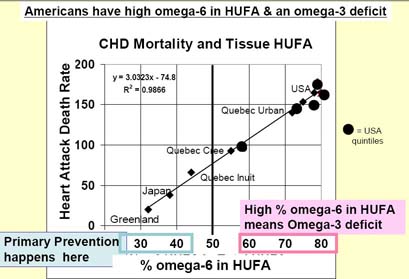
http://omega-6-omega-3-balance.omegaoptimize.com/files/8/9/8/7/3/147167-137898/Lands_Omega_6_Handout.pdf

There is an abundance of research pointing to the cardio-protective effects of omega-3, which is certainly important to diabetics, but there is very little information about how the omega-6 to omega-3 ratio predicts the progression of diabetes and diabetic complications. Based on the close correlation of omega-6 to omega-3 ratio and the CRP measure of inflammation, one can assume that this measure would also correlate closely with diabetic progression.

The above chart is from the Gene Smart Omega-3 Index Test website. The company works with Dr. Floyd Chilton author of Inflammation Nation to promote home tests for Omega-3 Index and Omega-6 to Omega-3 Ratio which they argue are better predictors of heart disease risk than other standard tests. Two observations: (1) The above graph does not include the Triglycerides/HDL Ratio which is generally believed to be the best predictor of heart disease. (2) The Omega-3 Index correlates very closely to CRP suggesting that the amount of omega-3 in the body tissue may be a key determinant of the body’s inflammation status. http://www.genesmart.com/

The above online test is being marketed for $150 which is still a little pricey even with the $30 discount, but other companies are also entering the market, which will hopefully bring the price down. I am not aware of any mainstream laboratories that are currently offering omega-6 to omega-3 ratio testing. Your doctor may not be aware of this testing.

Don’t expect to dramatically improve your omega-6 to omega-3 ratio overnight by chugging a bottle of fish oil. All indications are that changing the composition of your body tissue is a slow process. If you start conscientiously reducing inflammatory omega-6 in your diet and try to raise your omega-3 intake through healthy eating and supplementing with fish oil, it might be six months before you see a significant change and maybe a couple of years to achieve your optimal numbers. You are rebuilding your body one cell at a time.


Friday, March 19, 2010

Composition of Common Fats and Oils

The omega-6 polyunsaturated fatty acids (n-6 PUFA) and omega-3 (n-3 PUFA) are very imbalanced in the contemporary diet, with the typical American diet having an n-6:n-3 ratio of about 20:1, when a healthy and non-inflammatory n-6:n:3 ratio would be less than 2:1. The chart below lists common sources of fats and oils with their composition of the main fatty acids.

Generally speaking, the best fats and oils are those with the least amount of the inflammatory omega-6 and the most anti-inflammatory omega-3. Highly inflammatory arachidonic acid (AA or ARA), which is found in many animal protein sources, should be avoided unless the source is also rich in omega-3.


n-6 PUFA

n-3 PUFA

AA (ARA)

MUFA

SFA

Macadamia Oil

1.7%

0.3%

0%

78%

16%

Coconut Oil

1.8%

0%

0%

6%

87%

Cod Liver Oil

1.8%

21%

0.94%

47%

23%

Butter Fat

2.2%

1.4%

0%

29%

62%

Beef Tallow

3%

0.6%

0%

42%

50%

Cocoa Butter

3%

0.1%

0%

33%

60%

Fish Oil (Salmon)

5%

35%

0.68%

29%

20%

Fish Oil (Sardine)

8%

24%

1.76%

34%

33%

Palm Oil

9%

0.2%

0%

37%

49%

Lard

10%

1.0%

0%

45%

39%

Olive Oil

10%

0.8%

0%

73%

14%

Chicken Liver

10%

0.2%

6.75%

26%

32%

Hazelnut Oil

10%

0%

0%

78%

7%

Flax Seed Oil

13%

53%

0%

20%

9%

Avocado Oil

13%

1.0%

0%

71%

12%

Beef Liver

13%

0.2%

3.88%

13%

34%

Chicken Egg Yolk

13%

0.9%

1.65%

12%

36%

Almond Oil

17%

0%

0%

70%

8%

Chia Oil

19%

57%

0%

7%

10%

Canola Oil

19%

9%

0%

63%

7%

Chicken Fat

20%

1.0%

0.10%

45%

30%

Tea Seed Oil

22%

0.7%

0%

52%

21%

Pork Liver

22%

2%

12.05%

14%

32%

Sunflower Oil

29%

0%

0%

57%

9%

Peanut Oil

32%

0%

0%

46%

17%

Sesame Oil

42%

0%

0%

40%

14%

Pumpkin Seed Oil

42%

0%

0%

33%

18%

Soy Oil

51%

7%

0%

23%

16%

Walnut Oil

53%

10%

0%

23%

9%

Corn Oil

54%

1.2%

0%

28%

13%

Hemp Oil

60%

20%

0%

?

?

Grape Seed Oil

70%

0%

0%

16%

10%

Safflower Oil

75%

0%

0%

14%

6%

Source: USDA National Nutrient Database http://www.nal.usda.gov/fnic/foodcomp/search/

Omega-6: n-6 PUFA is more potent than n-3 PUFA in competing for metabolic events and storage space in human tissue. If it is too plentiful in one’s diet, it will displace omega-3 in the membrane phospholipids. Many chronic diseases (like diabetes) are mediated by excess omega-6. Most tissue receptors favor n-6 over n-3, so too much n-6 in diet will seriously impair the body’s ability to utilize n-3.

Different Omega-3: The EPA and DHA omega-3 contained in fish, other marine products, and some wild or grass-fed meats are the most bio-available. The ALA form of omega-3 which is found in plant foods is much less bio-available. The body must convert it to EPA or DHA before it has the beneficial properties of omega-3. Most people can only convert about 10 percent of ALA into EPA and less than 1 percent into DHA.

Arachidonic Acid: AA is the most inflammatory fatty acid in human tissue. The body needs some AA and can produce AA from n-6 PUFA, but too much may be deleterious to health. When n-6 and n-3 are in balance in the body, dietary AA is probably not a big problem. Some experts, however, recommend that people suffering inflammatory conditions avoid dietary AA. AA is only found in animal fats. The worst source is organ meats, followed by egg yolk. Poultry, while only having moderate amounts of AA, has more than other meats. Fish has AA, but it is not considered inflammatory as in has many more times healthy omega-3.

Monounsaturated Fat: After demonizing saturated fat, the food industry was hard put to discover a substitute for its “healthy” polyunsaturated fat when it became increasingly clear that PUFA was highly inflammatory and associated with many chronic diseases. MUFA appeared to be the obvious choice. Oleic acid, the most common MUFA, is abundant in olive oil and some nut oils which unfortunately have little or no omega-3. Another MUFA is erucic acid which is toxic in large amounts. Rapeseed has 30-60 percent erucic acid, but canola oil is a special form of rapeseed that has only 0.3-1.2 percent of this dangerous fatty acid and reduced amounts of glucosinolates, another dangerous compound in rapeseed.

Saturated Fat: SFA is still assumed to promote heart disease by most mainstream medicine and dietitians, but this theory is being increasing questioned by science and a growing number of low carbers. Frankly, the research is mixed. There are eight fatty acids called saturated. The SFAs found in most animal foods are long-chain fatty acids (14-18 carbons). Many plant foods have Medium Chain Triglycerides (MCT) with 6-12 carbons. These MCTs are the healthiest SFA. Lauric acid is an MCT which is the principal fat in coconut oil. It can also be found in human mother’s milk. MCTs promote immunity, better metabolism, can improve blood glucose and may reduce inflammation.